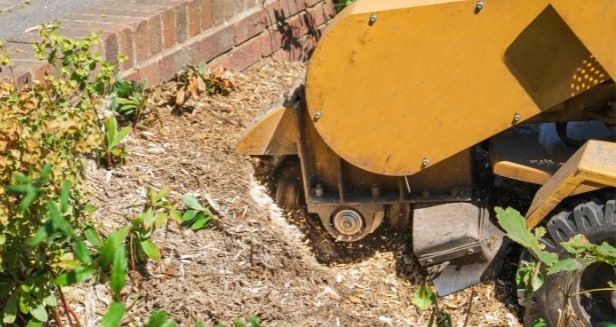
Redesigning a garden is an opportunity to reconsider how the outdoor space looks, functions and connects with the property. New lawns, planting areas, patios, paths and other features can completely change the way a garden is used. However, one existing feature can easily interfere with those plans: an old tree stump that has been left behind following previous tree removal.
For homeowners in Uckfield, East Sussex, removing unwanted tree stumps can be an important first step before wider garden improvements begin. At Uckfield Tree Surgeons, professional stump grinding allows old stumps to be reduced below ground level, helping create a clearer and more practical area for the next stage of the garden.
Why Are Tree Stumps Often Left Behind?
When a tree is felled, removing the above-ground tree and removing its stump are separate tasks.
The stump and major root structure remain firmly embedded in the ground after the trunk has been taken away. As a result, homeowners sometimes decide to leave the stump where it is, particularly if there is no immediate plan for that part of the garden.
Months or years later, circumstances can change. What was once an unobtrusive corner may become exactly where a new path, lawn, planting bed or seating area is wanted.
This is when the forgotten stump suddenly becomes a significant obstacle.
Old Stumps Restrict How a Garden Can Be Redesigned
A garden redesign works best when the available space can be considered as a whole.
An old stump creates a fixed obstruction that designers and homeowners must either incorporate into the layout or work around.
This can restrict:
- Lawn layouts
- New planting areas
- Paths and walkways
- Seating spaces
- General landscaping
- Access through the garden
- The positioning of other garden features
Removing the stump early provides greater freedom when deciding how the surrounding area should be used.
Why Stump Grinding Is Often the Practical Solution
Digging out a substantial tree stump manually can involve considerably more than removing the visible section.
Tree roots can spread extensively through the surrounding soil, making complete excavation highly disruptive.
Stump grinding takes a different approach.
Specialist machinery progressively grinds the stump down, including the main visible section and appropriate material below ground level. Rather than excavating the complete root network, the process concentrates on removing the obstruction created by the stump.
For many garden redesign projects, this is an effective way to prepare the area for its next use.
Creating a More Continuous Lawn
Old stumps can be particularly frustrating when homeowners want to create or extend a lawn.
Leaving the stump in place means the grass has to stop around it, creating an awkward interruption within what might otherwise be a continuous green space.
As the stump deteriorates, the surrounding ground can also become increasingly irregular.
Grinding the stump allows the area to be prepared more effectively as part of the wider lawn project.
The final preparation required will depend on the intended use and ground conditions, but removing the main stump eliminates a substantial obstacle from the outset.
Stumps Can Interfere With New Paths
A redesigned garden often includes new routes between the house, lawn, seating areas and other features.
An old stump positioned along the most practical route can force a path to change direction unnecessarily.
Building directly over an existing stump is generally undesirable because the woody material beneath the surface will continue changing as it naturally deteriorates.
Removing the obstruction first allows the new layout to be planned around the needs of the garden rather than around the remains of a tree that is no longer present.
They Can Limit New Planting Areas
Tree stumps can occupy valuable space within borders and planting areas.
Even when the stump itself is relatively small, large structural roots may be present immediately around it. This can make digging and preparing the surrounding soil more difficult.
Stump grinding can provide additional usable space and make it easier to develop a new planting scheme around the former tree position.
It is worth remembering that grinding a stump does not remove every root from the soil. Roots beyond the main stump generally remain underground and decompose naturally over time.
Forgotten Stumps Can Become Hidden Obstacles
A freshly cut stump is usually easy to see.
An older one can become less obvious as grass, weeds and surrounding plants grow around it.
This can create an awkward obstruction when walking through the garden or carrying out routine maintenance.
Low stumps can be particularly easy to overlook when partially concealed by vegetation.
Removing them during the early stages of a garden redesign creates a clearer area before new landscaping is introduced.
Stumps Can Make Lawn Maintenance More Difficult
Mowing and maintaining grass around a tree stump can become unnecessarily awkward.
Instead of following a straightforward route across the lawn, homeowners need to manoeuvre around the obstruction. Grass and weeds may also grow tightly around the edges where they are harder to manage.
If the tree itself has already gone and the stump serves no useful purpose, retaining it can make routine garden maintenance more complicated than necessary.
Stump grinding can help create a simpler, more accessible surface.
Old Stumps Can Produce New Shoots
Depending on the tree species and condition of the stump, new shoots can sometimes appear after felling.
This regrowth may develop from the stump or remaining root system and can become another maintenance issue.
Repeatedly cutting away shoots does not remove the original stump.
Where continued regrowth is a concern, professional assessment can determine an appropriate approach and whether stump grinding is suitable.
Natural Decay Can Take a Long Time
Leaving a stump to disappear naturally may sound simple, but substantial timber can remain in the ground for a considerable period.
The rate of deterioration depends on factors such as:
- Tree species
- Stump size
- Ground conditions
- Moisture
- Position
- The condition of the wood
Even as decay progresses, the stump may continue occupying valuable space.
For homeowners planning to redesign their garden now, waiting for natural decomposition may therefore be impractical.
Why Remove Stumps Before Other Landscaping Begins?
Timing can make a significant difference to the efficiency of a garden project.
If new landscaping is completed first and stump removal is considered afterwards, access for suitable machinery may become more restricted. Newly completed surfaces, planting and other features may also need to be worked around.
Removing unwanted stumps at the beginning creates a clearer working area.
A sensible sequence can be:
- Identify unwanted trees and existing stumps.
- Carry out appropriate tree work.
- Grind stumps that conflict with the proposed garden layout.
- Prepare the surrounding ground.
- Continue with the wider landscaping project.
Addressing obstacles first can make subsequent planning considerably more straightforward.
Access Should Be Considered Early
Professional stump grinding uses specialist equipment, so access to the stump needs to be considered.
Garden gates, narrow passages, steps, changes in ground level and nearby structures can all affect how the work is approached.
This is another reason to arrange stump assessment before the wider garden redesign is complete.
At Uckfield Tree Surgeons, we can assess the stump, its position and surrounding access before determining the appropriate method of removal.
Can You Simply Cover an Old Stump?
Covering the stump with soil or landscaping materials may hide it temporarily, but it does not remove the underlying timber.
The wood continues decomposing beneath the surface, potentially creating changes as material gradually breaks down.
If the area is intended for future landscaping, dealing with the stump properly before covering it provides a much better starting point.
The exact preparation required afterwards should reflect what will eventually occupy the space.
What Happens to the Roots After Stump Grinding?
Stump grinding does not normally involve excavating the entire root system.
The main stump is mechanically reduced, while roots extending further through the ground are generally left to break down naturally.
This avoids the extensive disturbance that would be required to excavate every root.
Where particular roots interfere with the planned use of the area, these can be assessed as part of the work.
Large Stumps Can Occupy More Space Than Expected
The visible diameter of a stump does not always show the full extent of the obstruction.
The base of the trunk can widen considerably where it meets the ground, with substantial roots extending into the surrounding area.
This becomes especially apparent when landscaping work starts close to the former tree position.
Professional stump grinding allows the main woody obstruction to be dealt with systematically rather than attempting to work around it during later stages.
Multiple Stumps Can Fragment a Garden
Properties that have undergone tree removal at different times can eventually contain several old stumps.
Individually, each may seem relatively insignificant. Collectively, they can divide the garden into awkward sections and substantially reduce the freedom available when planning a new layout.
Removing several redundant stumps can transform how the space can be approached.
Instead of designing around multiple fixed obstacles, homeowners can start with a clearer and more flexible garden area.
Stump Removal Can Make the Garden Feel More Finished
Old tree stumps can make a garden appear as though previous work was never completely finished.
Even in an otherwise well-maintained garden, a weathered stump surrounded by irregular growth can draw attention.
Removing it can create a cleaner foundation for new landscaping and help the garden feel more intentionally planned.
The benefit is not purely visual. The reclaimed space can also become genuinely useful again.
When Is the Best Time to Consider Stump Grinding?
If a garden redesign is being planned, the best time to consider unwanted stumps is usually before major new features are installed.
It is particularly worth arranging an assessment when:
- A stump occupies part of a proposed lawn
- A new path needs to cross the area
- The garden layout is being substantially changed
- Several old stumps remain from previous tree work
- A stump interferes with new planting
- The surrounding area needs to become easier to maintain
- New shoots continue appearing
- The stump has become a persistent obstruction
Early removal provides greater flexibility for whatever comes next.
Professional Stump Grinding Adds Value to Garden Preparation
Stump grinding requires suitable machinery and an understanding of how to work around the surrounding garden.
Every stump is different. Diameter, tree species, accessibility, surrounding roots and nearby features can all influence the approach.
At Uckfield Tree Surgeons, we assess these conditions before beginning work so that the stump can be reduced appropriately while considering the surrounding area.
For homeowners planning significant garden improvements, this professional preparation can provide a much more practical starting point.
Think About the Future Use of the Area
Before arranging stump grinding, it is useful to consider what you want to do with the space afterwards.
An area intended for lawn may require different subsequent preparation from one that will become a planting bed or part of another landscaped feature.
Understanding the future purpose of the area helps determine how the stump should be approached and what additional preparation may be needed after grinding.
This makes stump removal part of the wider garden plan rather than an isolated task.
Starting With a Clearer Garden Creates More Possibilities
One of the main advantages of removing forgotten stumps is flexibility.
A garden redesign should respond to how homeowners want to use their outdoor space today, rather than being dictated by trees that were removed many years ago.
Once unnecessary obstructions are addressed, it becomes easier to reconsider routes, planting, lawn areas and the general proportions of the garden.
Professional stump grinding can therefore be a small but important part of creating a more practical foundation for wider improvements.
Conclusion
Garden redesigns often begin with removing forgotten tree stumps because these old remnants can restrict layouts, interfere with lawns and paths, complicate planting and make everyday maintenance unnecessarily difficult. Although leaving a stump in place may initially seem harmless, it can become a significant obstacle once homeowners want to make better use of the surrounding space.
For homeowners in Uckfield, East Sussex, Uckfield Tree Surgeons provides professional stump grinding as part of our tree surgery services. If an old stump is standing in the way of your plans for the garden, our experienced team can assess its size, position and accessibility and provide suitable stump removal to help create a clearer area ready for its next use.
Call us on: 01825 705 493
Click here to find out more about Uckfield Tree Surgeons
Click here to complete our contact form and see how we can help with your tree care needs.