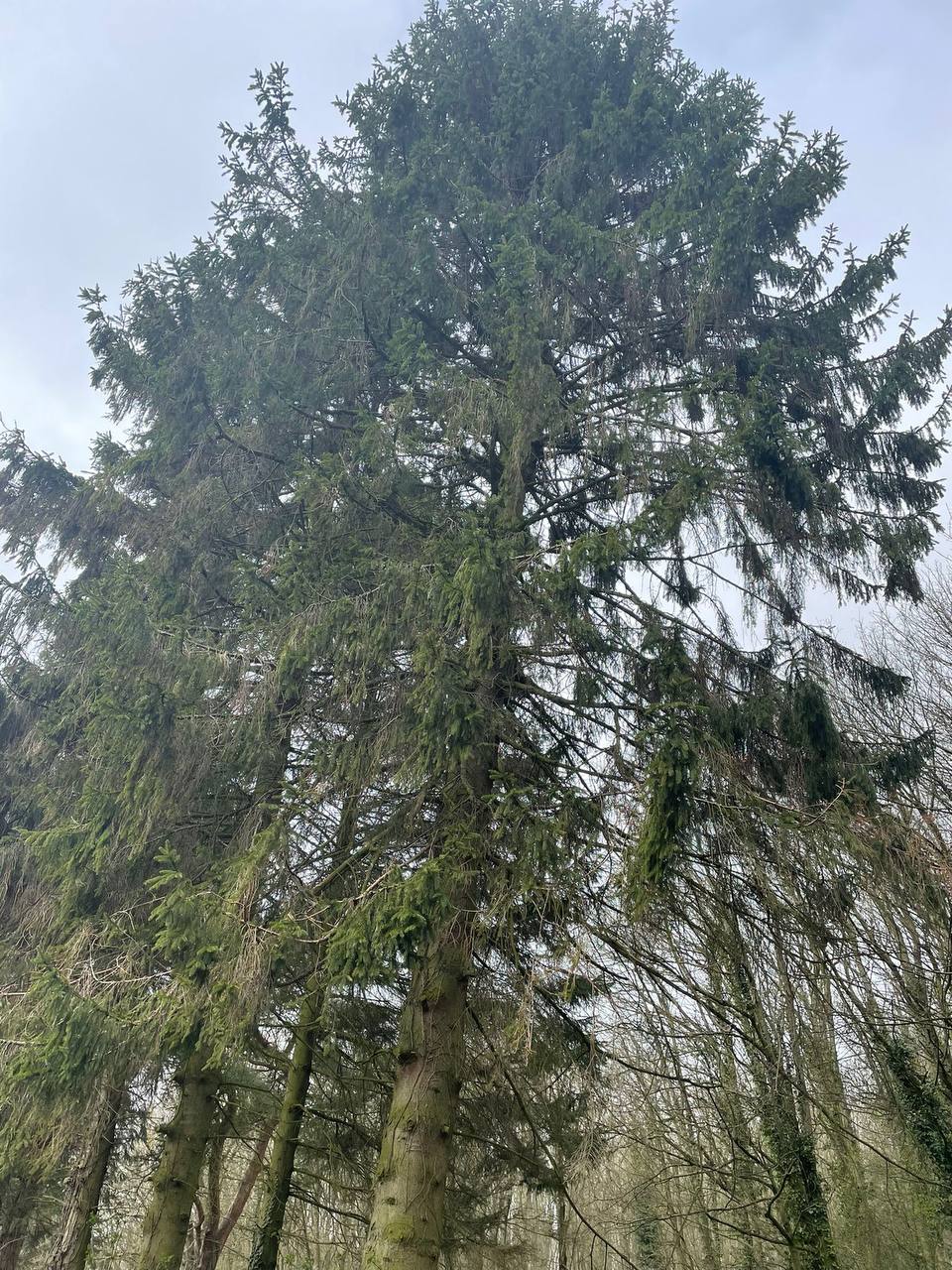
Trees naturally develop upwards and outwards as they mature, but sometimes the upper crown can become disproportionately large. Long leading branches, dense upper growth and an increasingly tall canopy can make a tree feel oversized for its surroundings, particularly when it has had little management for many years.
Excessive upper growth does not automatically mean that a tree needs to be removed or drastically cut back. Where the tree is otherwise suitable for retention, professional crown reduction can be used to reduce selected parts of the canopy while maintaining an appropriate overall structure.
For trees in Uckfield, East Sussex, crown reduction can provide a measured way of managing excessive upper growth without unnecessarily removing the tree. The key is to understand why the crown has developed as it has and determine how much reduction is appropriate for the individual tree.
How Does Crown Reduction Help Manage Excessive Upper Tree Growth?
Crown reduction involves selectively shortening branches around the outer canopy to reduce its overall dimensions. Where excessive growth is concentrated towards the top, carefully selected upper branches can be reduced back to suitable growth points rather than being indiscriminately cut.
The objective is not simply to make the tree shorter. Professional crown reduction considers height, spread, branch structure, species, maturity and the amount of healthy foliage that should remain.
This allows the upper crown to be managed while retaining a more natural and balanced form.
Excessive Upper Growth Can Develop Gradually
A tree rarely becomes oversized overnight.
Year after year, leading branches continue extending and smaller branches develop around them. If the tree has sufficient growing conditions and little previous management, the upper crown can eventually become much more prominent.
By the time the size becomes noticeable, substantial growth may already have developed throughout the canopy.
Some Trees Naturally Develop Strong Vertical Growth
Different tree species have different growth habits.
Some naturally form tall crowns with strong upright branches, while others develop broader or more spreading forms. This means that height alone does not necessarily indicate that a tree has become problematic.
Professional assessment considers whether the upper growth is genuinely excessive for the tree’s position rather than judging it against an arbitrary height.
Crown Reduction Is More Than Simply Lowering a Tree
Reducing height is often one objective, but it should not be considered in isolation.
A tall tree may also have long lateral branches or an uneven canopy. Simply shortening the highest point without considering the rest of the crown can create poor proportions.
Good crown reduction looks at the complete canopy and determines how selected areas can be reduced while maintaining a coherent structure.
Crown Reduction Is Different From Topping
One of the most important distinctions in tree management is the difference between crown reduction and indiscriminate topping.
Topping generally involves removing upper branches without adequately following the tree’s natural branch structure. This can leave large cuts and dramatically alter the crown.
Professional crown reduction instead works back to suitable pruning points throughout the canopy, providing a more considered approach to reducing excessive growth.
Excessive Height Does Not Automatically Require Tree Felling
A large tree can sometimes appear difficult to manage simply because of its height.
However, size alone is not necessarily a reason for removal. If the tree remains suitable for retention and its crown can reasonably be managed, reduction may provide an alternative.
The condition and structure of the tree should be assessed before deciding whether felling is necessary.
Long Upper Branches Can Become Disproportionate
The highest parts of a tree can contain branches that extend significantly beyond the surrounding crown.
These overextended branches may make the tree appear taller or more uneven than its main framework. Selectively shortening suitable growth can help bring these sections back into better proportion.
This is different from reducing every upper branch by exactly the same amount.
Uneven Upper Growth Can Be Addressed Selectively
Trees do not always develop evenly.
Access to light, surrounding vegetation, previous pruning and natural growth patterns can encourage one part of the crown to develop more strongly than another. This may create an upper canopy that appears weighted towards one direction.
Crown reduction can focus on the sections that have become particularly extended rather than unnecessarily reducing areas that already remain proportionate.
Previous Pruning Can Influence Upper Growth
A tree’s current shape often reflects work carried out in previous years.
Where branches have been heavily shortened in the past, vigorous shoots may subsequently have developed around the pruning points. If these shoots are allowed to mature, they can create dense or strongly vertical upper growth.
Understanding previous pruning helps determine how the crown should be managed now.
Vigorous Regrowth Needs Careful Management
Cutting a tree severely does not necessarily mean it will remain smaller for longer.
Some trees respond to substantial pruning by producing vigorous new shoots. These can grow rapidly and eventually create a dense upper canopy that requires further management.
This is one reason why proportionate reduction is preferable to simply removing as much height as possible.
Excessive Upper Growth Can Make the Crown Look Unbalanced
A tree’s visual proportions are influenced by the relationship between its height, spread and lower framework.
If upper branches have developed considerably beyond the rest of the crown, the tree can begin to appear top-heavy or awkwardly shaped. Suitable crown reduction can sometimes restore more appropriate proportions.
The objective should still be to respect the tree’s natural growth habit rather than creating artificial symmetry.
Crown Reduction Can Retain the Main Framework
One advantage of carefully planned reduction is that much of the established crown can remain.
Instead of removing major limbs unnecessarily, suitable branches are shortened while retaining appropriate secondary growth. This helps preserve the overall framework of the tree.
For mature trees in particular, retaining suitable established structure is an important consideration.
Large Trees Need Particularly Careful Pruning Decisions
The larger the tree, the more significant individual branches may be within its crown.
Removing a substantial upper limb can create a much larger change than pruning a small developing branch. This means mature or large trees require careful decisions about which branches should be shortened and which should remain.
Professional tree surgery aims to achieve useful management without unnecessary loss of established growth.
The Tree’s Species Influences How Much Reduction Is Appropriate
There is no single reduction specification suitable for every tree.
Different species vary in branch structure, growth rate, natural shape and response to pruning. The amount of upper growth that can reasonably be removed therefore needs to reflect the characteristics of the particular tree.
Applying the same approach indiscriminately can produce unsuitable results.
Tree Condition Must Be Considered Before Reducing the Crown
Before concentrating on excessive height, the wider condition of the tree needs consideration.
Deadwood, damaged limbs, weak branch unions, decay or previous structural damage may affect how pruning should be approached. These factors can sometimes alter which branches are suitable for retention.
Crown reduction should therefore follow assessment rather than being based on appearance alone.
Dead Upper Branches Require Different Treatment
Not every branch in the upper crown is healthy living growth.
Deadwood can sometimes be present among otherwise vigorous branches. Removing dead branches and reducing healthy crown growth are different tree surgery operations, even if they are carried out during the same visit.
Identifying the difference is important when deciding what the tree actually needs.
Crown Dieback Should Not Be Mistaken for Excessive Growth
A tree can sometimes have vigorous growth in certain areas while other parts of the crown are declining.
Sparse foliage, dead branch tips or sections that fail to produce normal growth may indicate a condition issue rather than simply an overgrown canopy.
In these circumstances, understanding the tree’s overall health and structure becomes more important than reducing its height.
Crown Reduction Can Help Manage Overextended Growth
Branches become overextended when they grow considerable distances beyond their main supporting structure.
Where suitable, shortening these branches can reduce the dimensions of the crown while retaining an appropriate framework.
This can be particularly useful when excessive upper growth is concentrated in several long branches rather than evenly distributed throughout the canopy.
Not Every Upper Branch Should Be Shortened
Crown reduction is selective by nature.
Some branches may already finish at appropriate positions and require little or no pruning. Others may be responsible for most of the excessive height.
Leaving suitable branches untouched helps avoid unnecessary removal of healthy foliage.
Suitable Pruning Points Matter
The location of each cut contributes to the quality of crown reduction.
Branches should not simply be shortened at arbitrary points to achieve a predetermined height. Suitable growth points need to be selected so the remaining branch structure makes sense.
This requires an understanding of branch form rather than simply measuring how much height should disappear.
Excessive Reduction Can Create Further Management Problems
Removing too much of the upper crown in one operation can be counterproductive.
Severe pruning can significantly alter the canopy and may encourage strong regrowth in some trees. Instead of creating an easier tree to manage, excessive cutting can sometimes result in another dense upper crown developing later.
A measured reduction is therefore often preferable.
Crown Reduction Does Not Permanently Stop Growth
Trees remain living, growing organisms after pruning.
New shoots will continue to develop and branches will gradually extend again. Crown reduction should therefore be viewed as a management technique rather than a permanent way of fixing a tree at one size.
The likely future growth of the tree should form part of the initial planning.
Future Growth Should Influence the Amount Removed
A successful reduction is not judged only by how the tree looks immediately afterwards.
How the remaining branches develop over the following years also matters. The tree should retain a suitable framework from which future growth can be managed.
This longer-term perspective helps avoid unnecessarily severe short-term pruning.
A Smaller Reduction May Sometimes Be More Appropriate
Homeowners may initially expect a large amount of height to be removed because the tree feels substantially overgrown.
After assessment, however, a more modest reduction may provide sufficient improvement while retaining a better crown structure. The greatest possible reduction is not automatically the most useful one.
The appropriate amount should be determined by the tree itself and the reason for the work.
Staged Crown Management Can Sometimes Be Useful
Where a tree has developed excessive growth over many years, achieving the desired management objective in one severe operation may not always be appropriate.
Depending on the tree, a more gradual approach may sometimes be preferable. This can allow its dimensions to be managed without making an unnecessarily dramatic change to the crown at one time.
Professional assessment helps determine whether staged work is appropriate.
Crown Reduction Can Improve the Relationship Between Tree and Garden
A tree does not exist independently from its surroundings.
As upper growth increases, the tree can begin to dominate the available space. Managing selected sections of the crown can help maintain a more appropriate relationship between the mature tree and the garden around it.
This can allow an established tree to remain without simply accepting unlimited crown expansion.
Reducing Upper Growth May Influence Light Levels
A very large or dense upper canopy can affect the amount of light reaching parts of the garden.
Crown reduction may create some improvement where selected growth is shortened, although it should not be treated as a way of making the entire canopy permanently open.
The primary objective remains appropriate tree management rather than removing unnecessary amounts of foliage.
Crown Reduction and Crown Thinning Are Not the Same
These terms can sometimes be confused.
Crown reduction decreases the overall dimensions of the canopy by shortening selected branches. Crown thinning focuses more on removing selected branches from within the canopy without necessarily reducing its external dimensions substantially.
The most appropriate technique depends on whether the main concern is size, density, structure or a combination of factors.
Selective Pruning May Sometimes Be Enough
Not every tree with prominent upper branches needs a complete crown reduction.
If only one or two branches are significantly overextended, targeted pruning may address the problem while leaving the remainder of the canopy unchanged.
Professional assessment can identify whether the issue genuinely involves the whole crown or only particular sections.
Regular Assessment Can Prevent Upper Growth Becoming Excessive Again
Once a suitable crown structure has been established, occasional assessment can help identify developing overextension before it becomes substantial.
This does not mean that a tree should automatically be pruned every year. Many trees require relatively little intervention.
Instead, monitoring future development allows work to be carried out when there is a clear reason rather than waiting until very heavy pruning is being considered.
Some Trees May Ultimately Be Unsuitable for Their Position
Crown reduction is useful, but it cannot make every tree appropriate for every location indefinitely.
If a tree’s natural mature dimensions are fundamentally incompatible with its surroundings, repeated severe reductions may not provide sensible long-term management.
This is why professional advice should consider both the immediate crown and how realistic continued management will be.
Why Professional Crown Reduction Adds Value
Reducing excessive upper growth involves much more than deciding how many metres should be removed from the top of a tree. Species, maturity, branch structure, condition, previous pruning and future growth all influence what should be done.
At Uckfield Tree Surgeons, we assess these factors before recommending crown reduction or alternative tree surgery. Where reduction is suitable, the aim is to manage excessive growth while retaining an appropriate framework and natural overall appearance.
For trees in Uckfield, East Sussex, this measured approach can help bring an oversized crown under better control without automatically resorting to excessive pruning or unnecessary removal.
Good Crown Reduction Is Based on the Individual Tree
Two trees of similar height can require very different approaches.
One may have a naturally proportioned crown that needs little intervention, while another may contain long, vigorous upper branches that have become disproportionate. Previous pruning and structural condition can create further differences.
For this reason, crown reduction should be specified according to the individual tree rather than using a standard amount of pruning in every situation.
Conclusion
Tree crown reduction can be particularly useful where excessive upper growth has made a tree too large or difficult to manage within its surroundings. By selectively shortening appropriate branches, the height and overall dimensions of the crown can be brought into better proportion while retaining a suitable established framework.
However, effective crown reduction is not simply a matter of cutting the top from a tree. The tree’s species, maturity, condition, natural form, previous pruning and likely future growth all need to influence how much work is appropriate.
If a tree at your property in Uckfield, East Sussex, has developed excessive upper growth, contact Uckfield Tree Surgeons. We can assess the crown and recommend whether professional crown reduction or more selective pruning would provide an appropriate way to manage the tree.
Call us on: 01825 705 493
Click here to find out more about Uckfield Tree Surgeons
Click here to complete our contact form and see how we can help with your tree care needs.